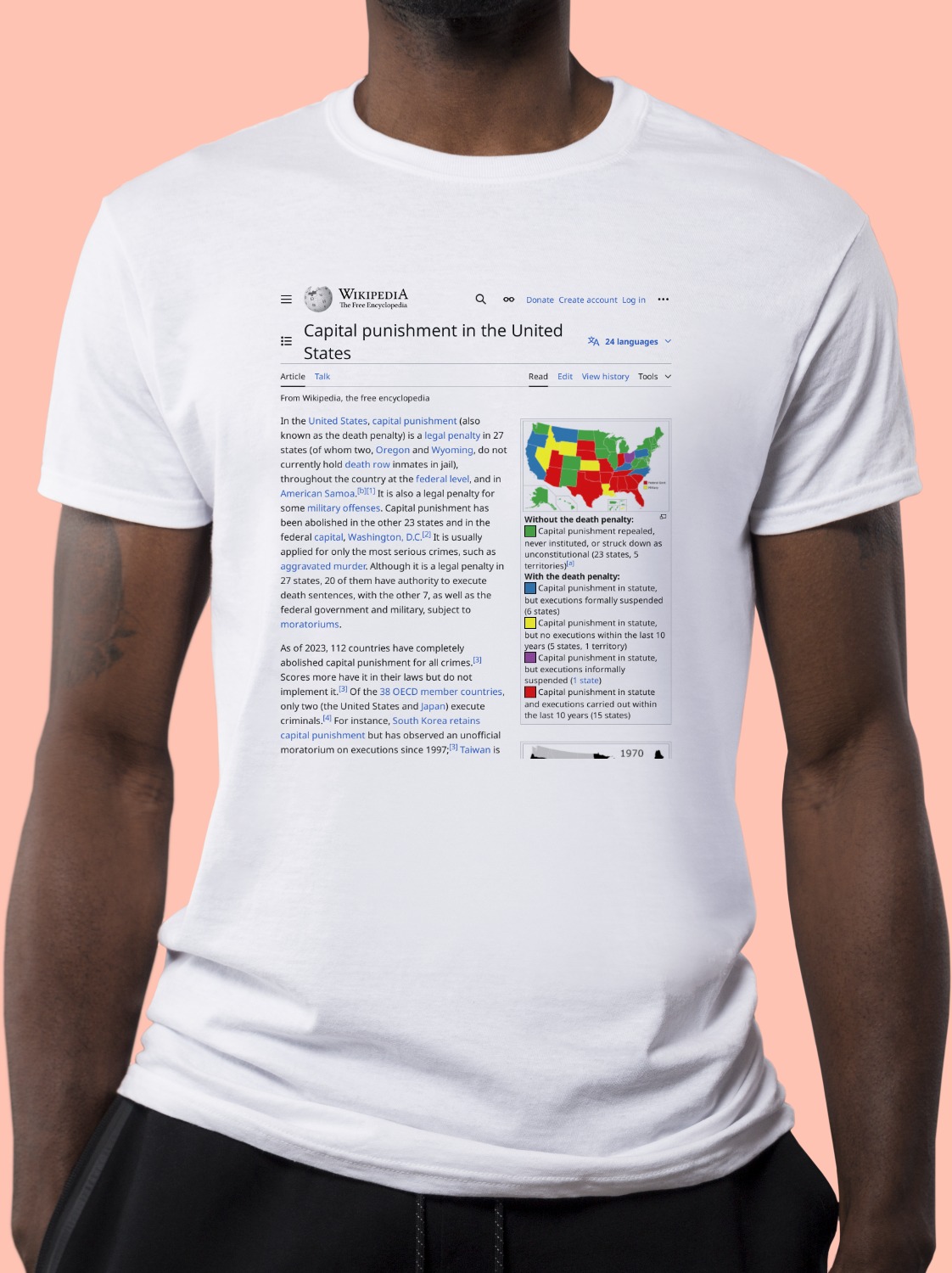
Capital punishment in the United States Shirt
A classic cotton tee emblazoned with the Wikipedia article on Capital punishment in the United States ↗.
- Preshrunk jersey knit
- Seamless double-needle 2.2 cm collar
- Taped neck and shoulders
- Tear away label
- Double-needle sleeve and bottom hems
- Quarter-turned to eliminate centre crease
In the United States, capital punishment (also known as the death penalty) is a legal penalty in 27 states (of which two, Oregon and Wyoming, have no inmates sentenced to death), throughout the country at the federal level, and in American Samoa. It is also a legal penalty for some military offenses. Capital punishment has been abolished in the other 23 states and in the federal capital, Washington, D.C. It is usually applied for only the most serious crimes, such as aggravated murder. Although it is a legal penalty in 27 states, 21 of them have authority to execute death sentences, with the other 6 subject to moratoriums.
As of 2025, three of the 38 OECD member countries, that being the United States, Japan, and South Korea retain the death penalty. South Korea has observed an unofficial moratorium on executions since 1997. Thus, Japan and Taiwan are the only other advanced democracies with capital punishment. In both countries, the death penalty remains quite broadly supported.
Capital punishment in the United States can be traced to early colonial Virginia. There were no executions in the United States between 1967 and 1977. In 1972, the Supreme Court of the United States struck down capital punishment statutes in Furman v. Georgia, reducing all pending death sentences to life imprisonment. Subsequently, a majority of states enacted new death penalty statutes, and the court affirmed the legality of the practice in the 1976 case Gregg v. Georgia. Since then, more than 8,500 defendants have been sentenced to death; of these, more than 1,605 have been executed. Most executions are carried out by states. For every 8.2 people executed, one person on death row has been exonerated, in the modern era. At least 200 people who were sentenced to death since 1973 have been exonerated. That would be about 2.2% or one in 46.
In 2019, the Trump administration's Department of Justice announced its plans to resume executions for federal crimes. On July 14, 2020, Daniel Lewis Lee became the first inmate executed by the federal government since 2003. Thirteen federal death row inmates were executed, all under Trump. The last and most recent federal execution was of Dustin Higgs, who was executed on January 16, 2021. On July 1, 2021, Attorney General Merrick Garland imposed a moratorium on federal executions. In April 2022, 2,414 people were on federal or state death row.
On December 23, 2024, President Joe Biden commuted the sentences of 37 of the 40 individuals on federal civilian death row to life imprisonment without the possibility of parole; 3 people remain on federal death row. Pursuant to Executive Order 14164, signed by Donald Trump on January 20, 2025, the first day of his second term, Attorney General Pam Bondi issued a memorandum on February 5, 2025 that rescinded the Garland moratorium on federal executions. The memorandum also directed the Justice Department to strengthen the death penalty and seek its application by prosecutors whenever reasonable.
The last public execution in the U.S. was of August 14, 1936, in Kentucky before a crowd of 20,000 people. This was followed by a period from 1936 to 1937 where executions were semi-public and after which most states began requiring executions to be held privately. Laws generally prohibit public attendance, though journalists and selected individuals may witness them. Timothy McVeigh's 2001 execution was viewed by over 200 people, mainly victims' families, via closed-circuit TV.
About Wikishirt
Wikishirt is a retail experiment that lets you buy a shirt with any Wikipedia Article printed on it. There are over 5 million Wikipedia articles, so we have over 5 million shirts.Check out our homepage for random featured shirts and more!