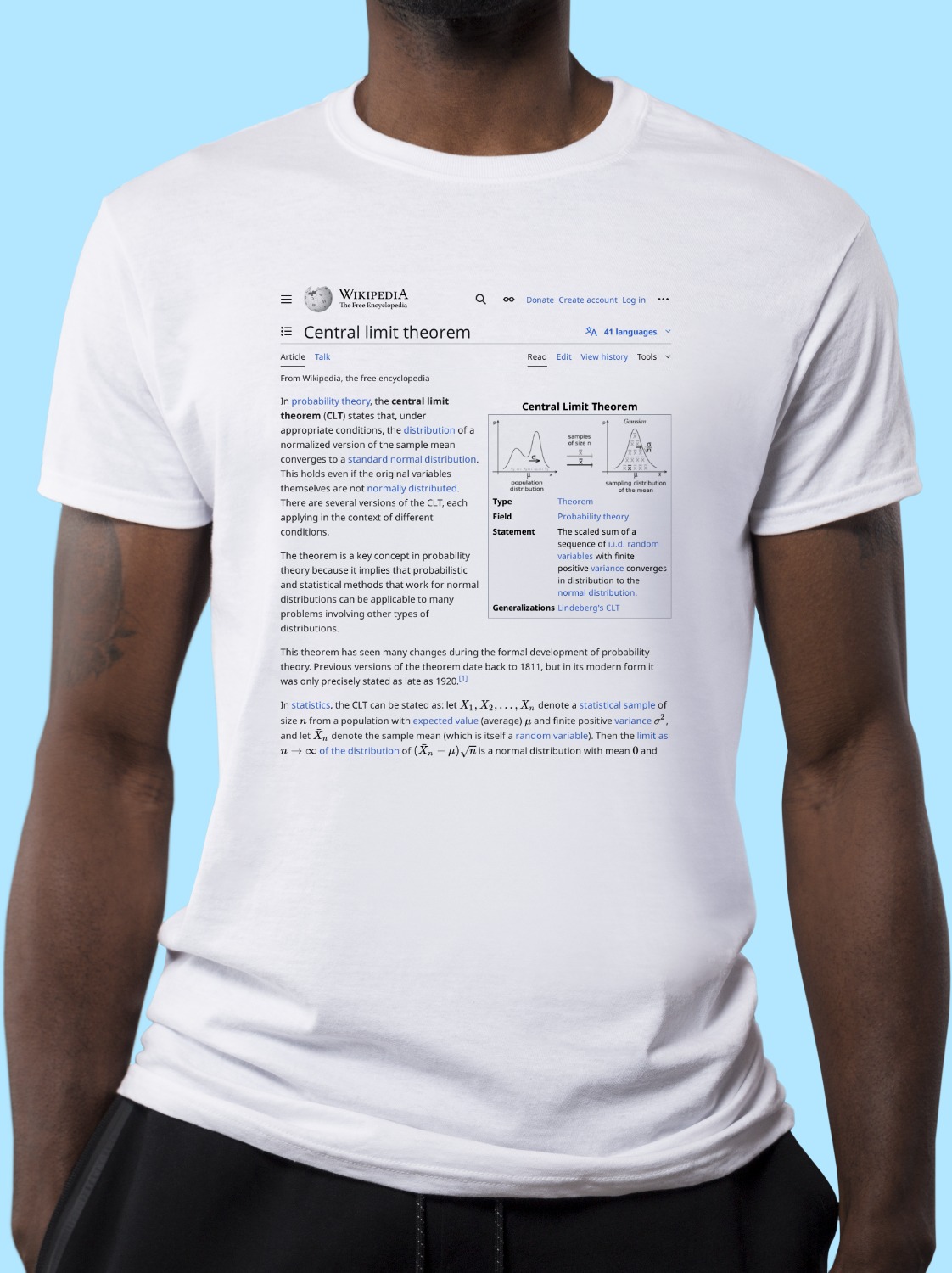
Central limit theorem Shirt
A classic cotton tee emblazoned with the Wikipedia article on Central limit theorem ↗.
- Preshrunk jersey knit
- Seamless double-needle 2.2 cm collar
- Taped neck and shoulders
- Tear away label
- Double-needle sleeve and bottom hems
- Quarter-turned to eliminate centre crease
In probability theory, the central limit theorem (CLT) states that, under appropriate conditions, the distribution of a normalized version of the sample mean converges to a standard normal distribution. This holds even if the original variables themselves are not normally distributed. There are several versions of the CLT, each applying in the context of different conditions.
The theorem is a key concept in probability theory because it implies that probabilistic and statistical methods that work for normal distributions can be applicable to many problems involving other types of distributions.
This theorem has seen many changes during the formal development of probability theory. Previous versions of the theorem date back to 1811, but in its modern form it was only precisely stated in the 1920s.
In statistics, the CLT can be stated as: let denote a statistical sample of size from a population with expected value (average) and finite positive variance , and let denote the sample mean (which is itself a random variable). Then the limit as of the distribution of is a normal distribution with mean and variance .
In other words, suppose that a large sample of observations is obtained, each observation being randomly produced in a way that does not depend on the values of the other observations, and the average (arithmetic mean) of the observed values is computed. If this procedure is performed many times, resulting in a collection of observed averages, the central limit theorem says that if the sample size is large enough, the probability distribution of these averages will closely approximate a normal distribution.
The central limit theorem has several variants. In its common form, the random variables must be independent and identically distributed (i.i.d.). This requirement can be weakened; convergence of the mean to the normal distribution also occurs for non-identical distributions or for non-independent observations if they comply with certain conditions.
The earliest version of this theorem, that the normal distribution may be used as an approximation to the binomial distribution, is the de Moivre–Laplace theorem.
About Wikishirt
Wikishirt is a retail experiment that lets you buy a shirt with any Wikipedia Article printed on it. There are over 5 million Wikipedia articles, so we have over 5 million shirts.Check out our homepage for random featured shirts and more!