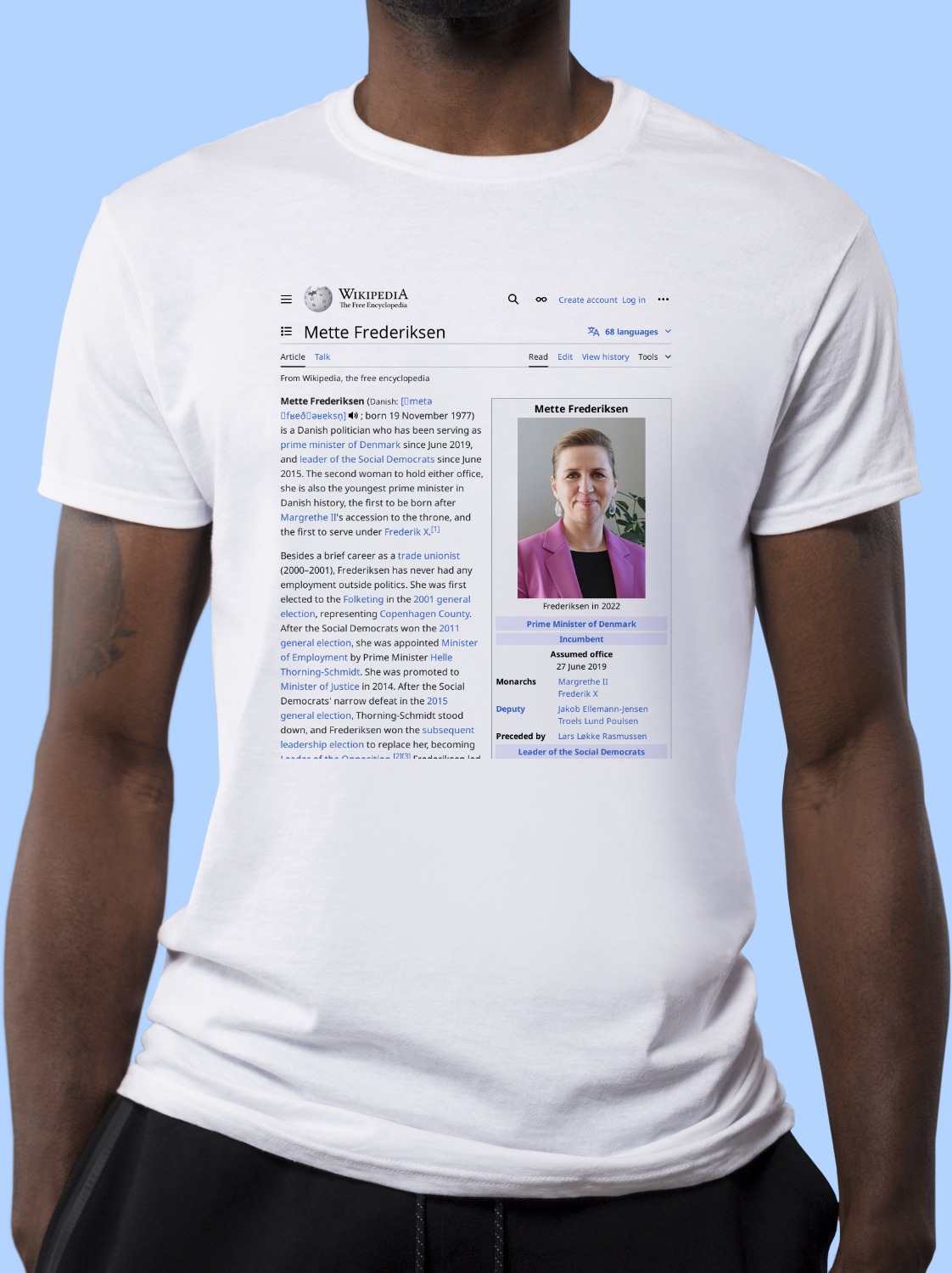
Mette Frederiksen Shirt
A classic cotton tee emblazoned with the Wikipedia article on Mette Frederiksen ↗.
- Preshrunk jersey knit
- Seamless double-needle 2.2 cm collar
- Taped neck and shoulders
- Tear away label
- Double-needle sleeve and bottom hems
- Quarter-turned to eliminate centre crease
Mette Frederiksen (Danish: [ˈmetə ˈfʁeðˀəʁeksn̩] ; born 19 November 1977) is a Danish politician who has served as Prime Minister of Denmark since 2019 and Leader of the Social Democrats since 2015. The second woman to hold either office, she is also the youngest prime minister in Danish history, the first to be born after Margrethe II's accession to the throne, and the first to serve under Frederik X.
Frederiksen worked briefly as a trade unionist (2000–2001) before embarking on a political career. She was first elected to the Folketing in the 2001 general election, representing Copenhagen County. After the Social Democrats won the 2011 general election, she was appointed Minister of Employment by Prime Minister Helle Thorning-Schmidt. She was promoted to Minister of Justice in 2014. After the Social Democrats' narrow defeat in the 2015 general election, Thorning-Schmidt stood down, and Frederiksen won the subsequent leadership election to replace her, becoming Leader of the Opposition. Frederiksen led her party into the 2019 general election, which resulted in the bloc of left-wing and centre-left parties (her Social Democrats, the Social Liberals, the Socialist People's Party, the Red–Green Alliance, the Faroese Social Democratic Party, and Greenland's Siumut and Inuit Ataqatigiit) winning a majority in the Folketing. Frederiksen was subsequently commissioned by Queen Margrethe II to lead negotiations to form a new government, and was sworn in as prime minister on 27 June. In December 2021, she became the longest-serving incumbent female head of government in the European Union.
Her first cabinet steered Denmark through the COVID-19 pandemic. In July 2022, Frederiksen's government was criticised by the Mink Commission for its handling of the COVID-19 mink outbreak, although she was cleared of deliberately misleading the public. Under pressure from the Social Liberals, she called an early election for 1 November 2022 in which the Social Democrats won their best result in twenty years, while Frederiksen secured the highest personal vote; she subsequently formed a coalition government with Venstre and the Moderates, remaining prime minister.
In domestic politics, Frederiksen has pursued an extremely hardline refugee and immigration policy, which has earned her both criticism and praise. She has steered the Social Democrats towards the political centre, combining strict migration and law-and-order policies with support for the welfare state and stronger defence, an approach credited with containing the far right and cited as a rare success within the Party of European Socialists, but also seen as alienating younger progressive urban voters, especially in Copenhagen. In 2020, her government enacted the Climate Act mandating a 70% reduction in greenhouse gas emissions by 2030, but has been criticised for slow implementation, despite a 2024 agreement introducing a tax on agricultural emissions, including livestock flatulence, the first of its kind globally. In social policy, she has granted earlier retirement to certain manual workers, strengthened vocational education and curtailed master's programmes.
In foreign policy, Frederiksen initially expressed scepticism towards the EU, particularly with regard to immigration and the economy, and was even considered one of the most EU-sceptical prime ministers in Danish history. However, this has since changed dramatically, particularly as a result of Russia's invasion of Ukraine. In light of this, she has subsequently abandoned fiscal conservatism, now supports European common debt, and has officially withdrawn from the Frugal Four. In defence and security policy, Frederiksen has adopted a hawkish line, emphasising the importance of NATO, and especially the United States. She is regarded as one of Ukraine's staunchest supporters, and under her tenure Denmark became its largest economic and military contributor relative to GDP. Denmark also increased defence spending to over 2% of GDP in 2024 and surpassed 3% in 2025–26. In 2022, she won a referendum on abolishing Denmark's EU defence opt-out, and also extended conscription and expanded it to include women. She was named the second most powerful individual in Europe in 2025 by Politico, which described her as one Europe's "most pragmatic operators" and noted her influence on steering EU policy on migration, defence and strategic autonomy.
About Wikishirt
Wikishirt is a retail experiment that lets you buy a shirt with any Wikipedia Article printed on it. There are over 5 million Wikipedia articles, so we have over 5 million shirts.Check out our homepage for random featured shirts and more!