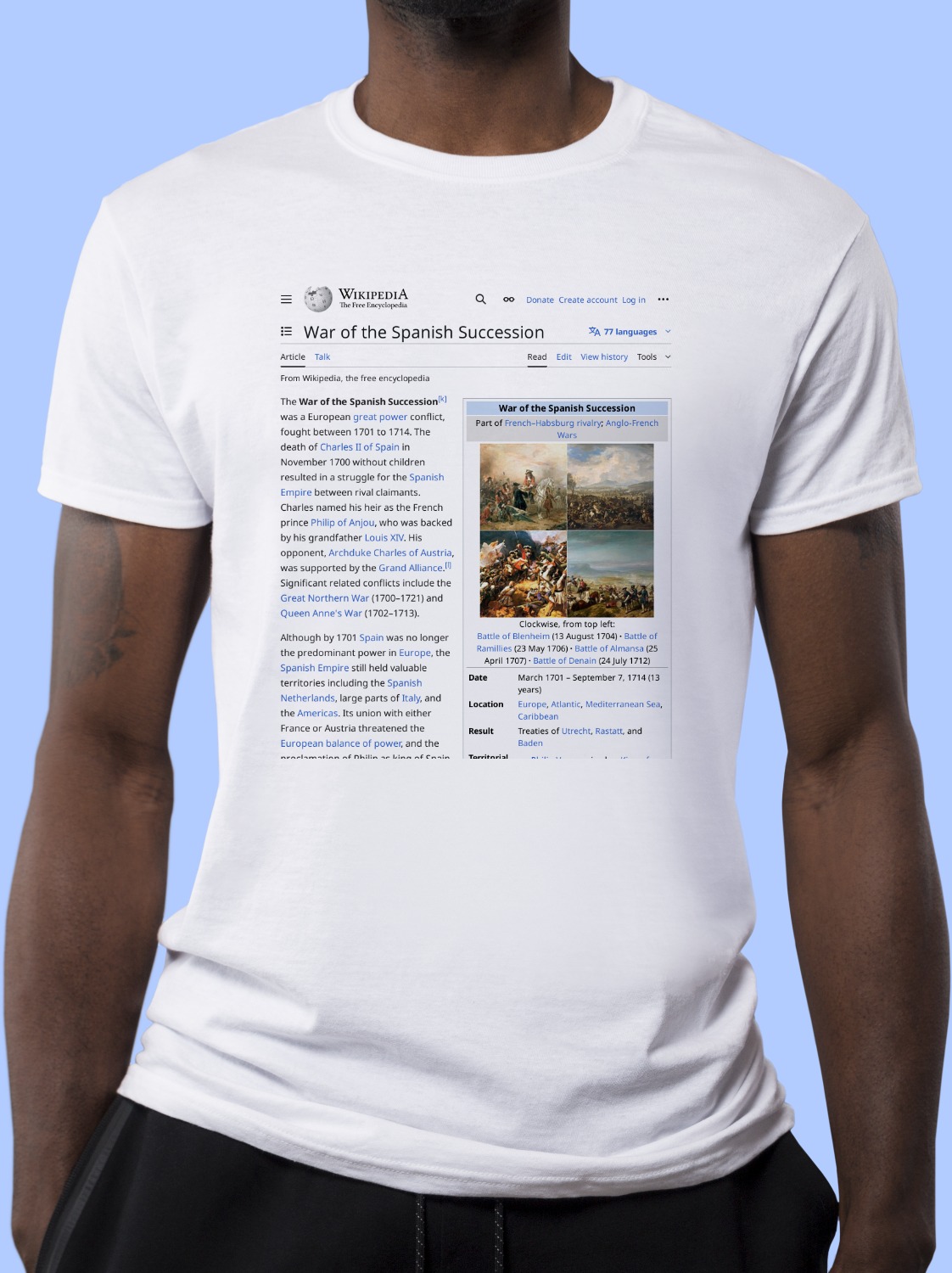
War of the Spanish Succession Shirt
A classic cotton tee emblazoned with the Wikipedia article on War of the Spanish Succession ↗.
- Preshrunk jersey knit
- Seamless double-needle 2.2 cm collar
- Taped neck and shoulders
- Tear away label
- Double-needle sleeve and bottom hems
- Quarter-turned to eliminate centre crease
The War of the Spanish Succession was a European great power conflict, fought between 1701 and 1714. The death of Charles II of Spain in November 1700 without children resulted in a succession struggle between Philip of Anjou, the nominated heir who was backed by his grandfather Louis XIV of France. His opponent, Archduke Charles of Austria, was supported by the Grand Alliance. Significant related conflicts include the Great Northern War (1700–1721) and Queen Anne's War (1702–1713).
Although no longer the predominant power in Europe, the Spanish Empire remained a vast global power, including the Spanish Netherlands, large parts of Italy, the Americas and the Spanish East Indies. Its union with either France or Austria threatened the European balance of power, and the proclamation of Philip as king of Spain on 16 November 1700 led to war. Although by 1709 the Grand Alliance had forced France onto the defensive, Philip had confirmed his position in Spain, the ostensible cause of the war.
When Emperor Joseph I died in 1711, Archduke Charles succeeded him as Holy Roman Emperor. Union with Austria was as unwelcome as that with France, while mounting costs led the new British government to withdraw from the war. The Grand Alliance's remaining forces continued to fight until British military and financial support collapsed. This led to the 1713 Peace of Utrecht, followed by the treaties of Rastatt and Baden in 1714.
Philip was confirmed as King of Spain, but renounced his place in the French line of succession. In addition, most Spanish possessions in Italy were ceded to Savoy and Austria, which also acquired the Austrian Netherlands. Britain retained the Spanish ports of Gibraltar and Menorca, along with trade concessions in the Americas. This established the British as the primary European commercial entity, replacing the Dutch, who thereafter declined as a significant power despite securing their barrier fortresses and gaining part of Upper Guelders. France was left financially exhausted but placing a Bourbon on the Spanish throne meant it had succeeded in the long envisioned goal of breaking the encirclement of its borders by the Habsburg monarchy.
About Wikishirt
Wikishirt is a retail experiment that lets you buy a shirt with any Wikipedia Article printed on it. There are over 5 million Wikipedia articles, so we have over 5 million shirts.Check out our homepage for random featured shirts and more!